Future-proof e-production and logistics under a single roof
io develops and implements logistics and hygiene protocols
New production environment for electric mobility
The BMW Group has created a production environment at the Landshut site that meets the highest standards of technical cleanliness and efficient material flows. io developed a holistic hygiene and logistics protocol that forms the basis for production of particularly sensitive components.
The aim was to create stable operating conditions for production of complex components under strictly controlled conditions, and at the same time to largely automate the supply of materials. At the heart of this is a high-precision control unit whose quality and purity can only be guaranteed in special environments. Production therefore takes place in ultra-clean and clean rooms in accordance with ISO 9 and VDA 19.
An additional challenge was to implement the entire system in an existing building, which first had to be adapted to the new requirements.

io developed a logistics protocol for sensitive components
Holistic hygiene approach
The first item on the agenda was a comprehensive on-site analysis. io used this to develop a hygiene protocol that takes all key factors into account – from staff routes and changing areas, right down to suitable protective clothing.
Particular attention was paid to humans as a potential source of particles. Today, the hygiene zone comprises two production lines, cleanliness laboratories and a direct connection to the conveyor system. An intelligent ventilation system with a pressure cascade separates the different cleanliness areas and reliably protects against the ingress of particles.

Clean room laboratories and ventilation system ensure the highest production standards
Key Facts
Client
The BMW Group is one of the world’s leading premium manufacturers of automobiles and motorcycles. io developed a holistic hygiene and logistics approach for the Landshut site to ensure the production of pioneering vehicle components to stringent cleanliness and efficiency standards and to automate the existing plant logistics, creating extra storage capacity.
The challenge
- Setting up a production environment for particularly sensitive components
- Integrating a clean room solution into existing building structures
- Preventing particle contamination through strictly controlled cleanliness zones
- Extensive automation of goods flow and material supply
- Adapting logistics facilities to the existing property’s structural limitations
The solution
- Double-deep high-bay warehouse with more than 30,000 storage spaces
- Automated small parts warehouse with around 18,000 storage spaces
- Implementing a consistent hygiene protocol including personnel management, changing areas and protective clothing
- Installing ISO 9-compliant ultra-clean rooms and VDA 19-compliant clean rooms
- Introducing a graduated ventilation system with a defined pressure cascade
- Redesigning highly automated logistics processes
- Connecting warehouse, loading tunnels and production via electric floor conveyor and conveyor technology
- Flexible material provision – from small to large load carriers
Highly automated logistics
In parallel with the new production, the whole logistics process was reorganized. As well as supplying the new line, the existing plant logistics had to be automated and extra storage capacity created.
To achieve this, io developed various layouts and technical variants, focusing on the interface between logistics and production. The result is a process that ranges from automated goods receipt with destacking as well as product recognition through to delivery to the precise points of demand.


Seamless integration into existing structures
While large load carriers are moved directly via the conveyor system, small load carriers are transferred directly to production via lifters or transfer racks.
Integrating the new systems into the existing hall posed particular challenges. These included having to reinforce the base plate to accommodate the planned storage facilities.
Optimized material flow from warehouse to production
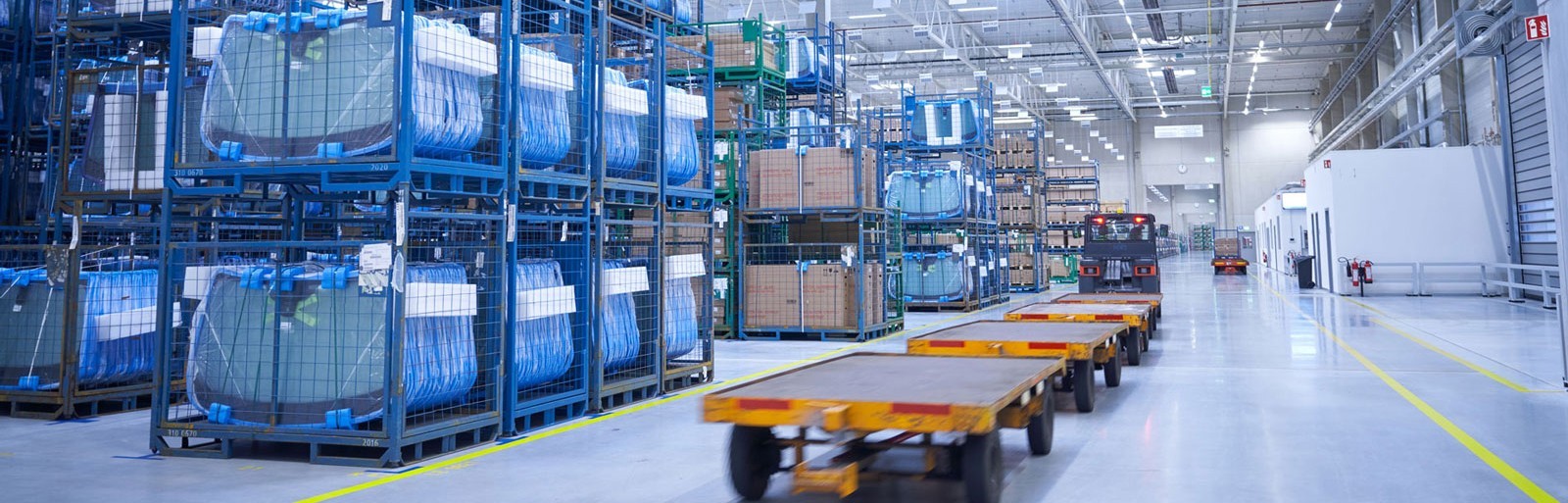
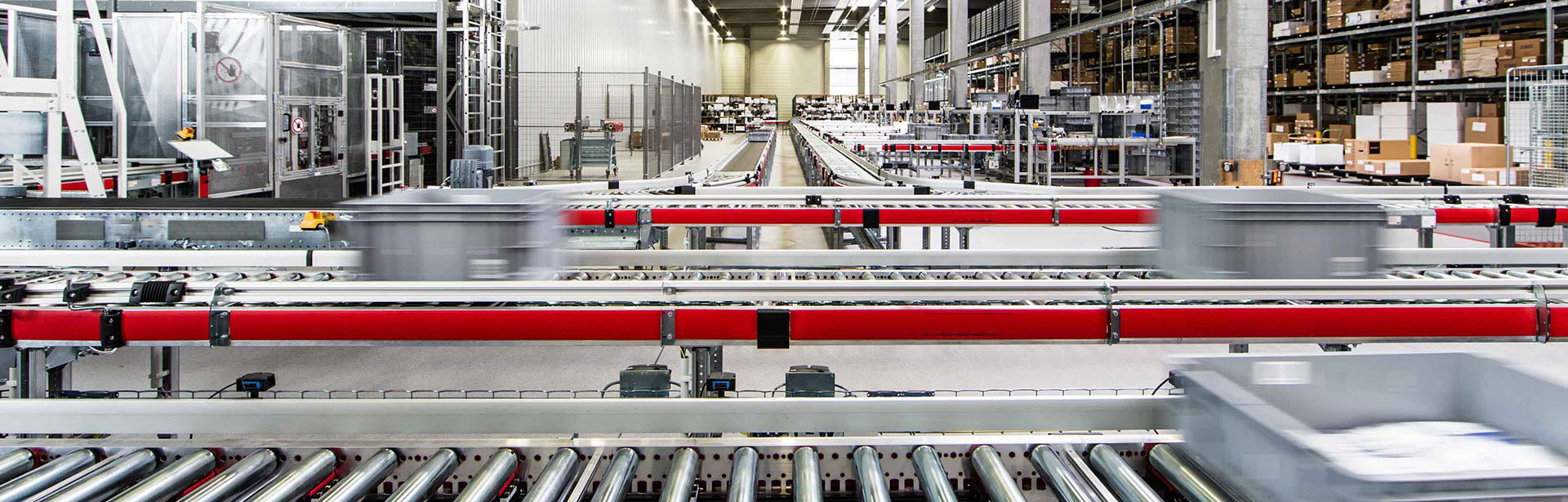
The result was an efficient logistics solution. A double-deep high-bay warehouse with more than 30,000 storage spaces adds to an automated small parts warehouse with around 18,000 storage spaces. The material flow is ensured by an electric floor conveyor that links the warehouse, loading tunnel and production. In addition, modern container conveyor technology enables direct supply to production. This means that a wide variety of load carriers can be moved.


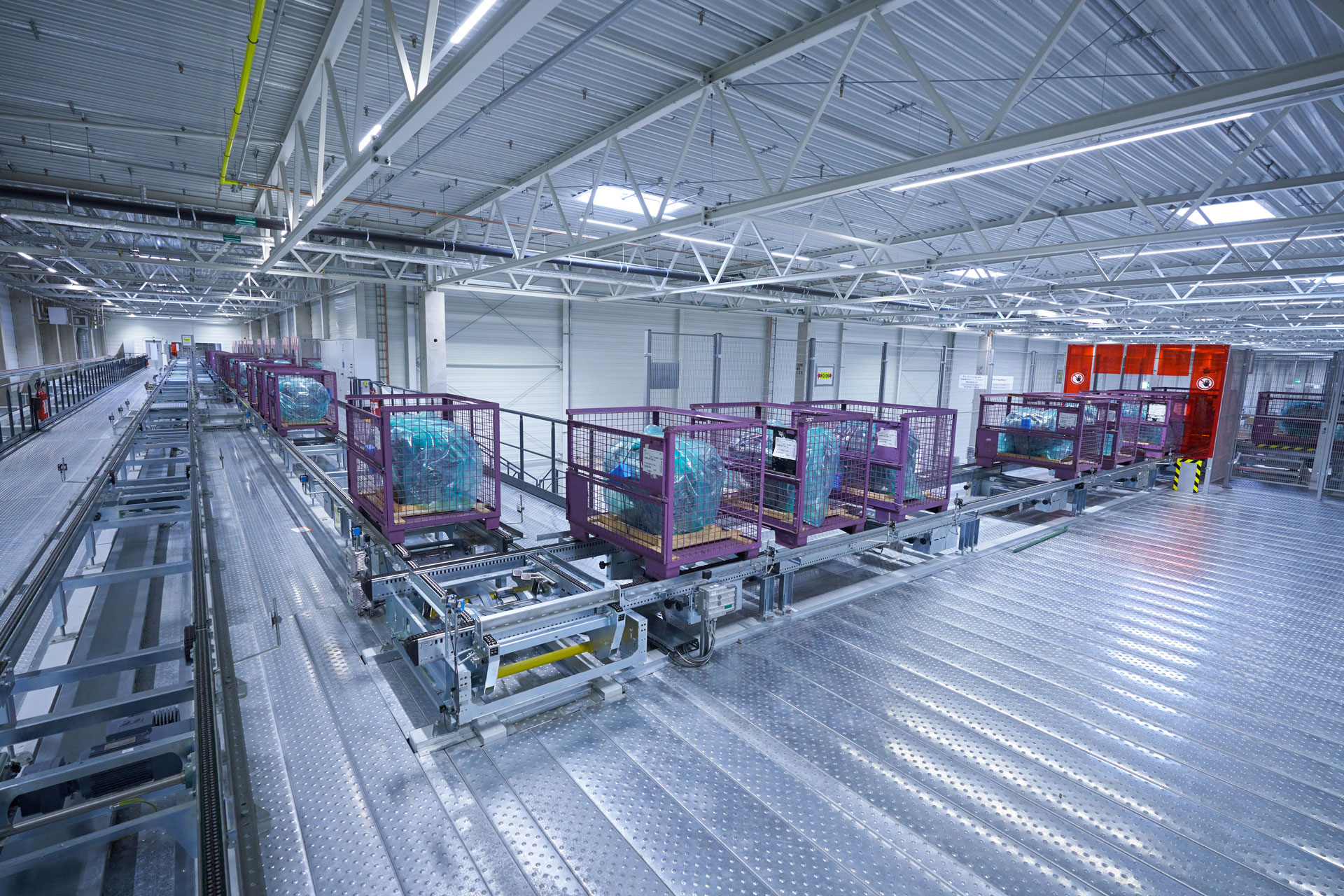


Planning in an existing property. io saw the project through to successful commissioning.
Establishment of a central incoming goods and prepackaging center.
The electric floor conveyor connects all the functional and storage areas with each other.
9-fold pallet loading with automatic destacker.
The starting point was an existing logistics property.
Installation of the SRM in the existing hall.